


Understanding Domain Authority in SEO

If you've been around the SEO world, you've likely heard about "domain authority." It's a key metric, but often misunderstood. It's seen as a way to measure how well a website ranks on the search engine results pages compared to others.
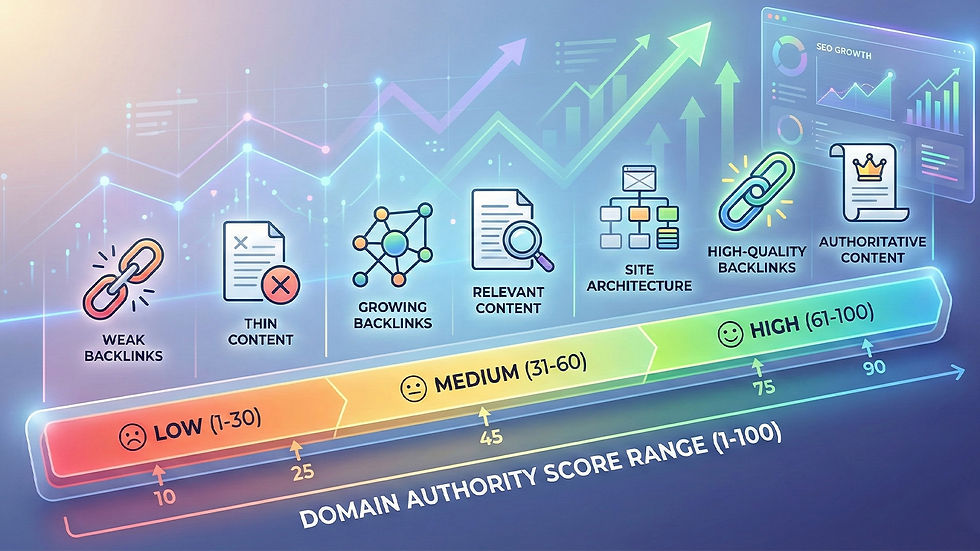
Domain authority metric is a score from Moz that shows how well a website ranks. It's like a report card for your domain, scoring from 1 to 100. A higher score means you're more likely to rank well.
Many people get confused about domain authority. It's not a direct ranking factor for Google. Instead, it's a tool to compare your SEO with others. It shows you where you stand, not what Google should do.
The score relies on backlink data from Moz's Link Explorer. An algorithm looks at the quality and number of links to your site. So, if your backlink profile changes, your score will too.
At Illumination Marketing in Houston, Texas, we find that knowing about DA is crucial to you SEO strategy. It's not everything, but it's a good start. Let's dive deeper into how it works.
Key Takeaways
Domain authority is a predictive SEO metric developed by Moz, scored on a scale from 1 to 100.
DA is not a direct Google ranking factor — it's a comparative benchmark for evaluating SEO performance against competitors.
The score is calculated using a machine learning algorithm that focuses primarily on backlink quality and quantity.
Your domain authority fluctuates over time as your backlink profile and the competitive landscape change.
A higher DA score signals stronger ranking potential, but it should be used alongside other search engine metrics.
Improving your DA requires earning quality backlinks, cleaning up toxic links, and strengthening your overall SEO foundation.
What Is Domain Authority and Why It Matters for SEO Performance
Let's get into it. Domain Authority is a score from Moz that shows how well your site can rank on search engines. It's a key SEO tool in your arsenal.
Think of it as your site's report card. It helps you compare with others, see how your SEO is doing, and plan better strategies.
The Moz Metric That Predicts Ranking Potential
Moz made Domain Authority to compare sites, not to rank them absolutely. It uses data and machine learning to guess your ranking chances. Every site starts at 1 and goes up as it gets quality links. Big sites like Wikipedia have high scores because they have lots of trusted links.
Domain Authority Score Range and Interpretation
DA scores range from 1 to 100. But, it's not just about the number. A score of 30 might be great for a small bakery but not for a big media site. Always compare your score to your competitors.
DA Score Range | Competitive Level | Typical Website Type |
1–20 | Low | New sites, small blogs |
21–40 | Moderate | Growing businesses, niche sites |
41–60 | Strong | Established brands, popular blogs |
61–80 | Very Strong | Large companies, news outlets |
81–100 | Elite | Major platforms (Google, Wikipedia) |
How DA Differs from Google's Ranking Algorithms
Google doesn't use Domain Authority to rank sites. Its algorithm looks at many things, like content and user experience. DA is a tool to help you, not a direct ranking factor. Even with a low website authority, your site can still rank high with good SEO and content. Use DA to guide your SEO, not as a promise.

How Domain Authority Is Calculated and Measured
Ever wondered what's behind the numbers? It's fascinating to learn how Moz's score works. It's not just one formula. It's a complex system that uses many data points to guess your site's ranking chances.
Machine Learning Algorithm and Backlink Factors
Moz's model is trained on real Google data. It checks link quality, spam, and metrics like MozRank and MozTrust. By comparing patterns, it predicts how well you'll rank.
The Role of Linking Root Domains in Your DA Score
Linking root domains are key. They're unique sites linking back to you. More diverse links mean more trust and recognition online.
Linking Root Domains Count | Typical DA Range | Difficulty to Grow |
0–50 | 1–20 | Easy |
50–500 | 20–40 | Moderate |
500–5,000 | 40–60 | Challenging |
5,000+ | 60–100 | Very Difficult |
For a good DA score, get links from various quality sources. Diverse linking domains are your strength.
Why Domain Authority Scores Fluctuate Over Time
Your DA score changes over time. It's influenced by Moz updates, backlink changes, or competitors' links. Big changes, like Facebook's, can affect your score.
To boost your DA, aim for steady link growth. It's easier to go from 20 to 30 than from 70 to 80. Now you know how DA is measured, let's compare it with other SEO metrics.

Domain Authority vs. Other SEO Metrics
DA is just one part of a bigger puzzle. We've talked about authority before. Now, let's compare it to other important metrics.
Checking domain authority shows your domain's overall strength. Page Authority (PA) looks at a single URL. Think of DA as the team's record and PA as an individual's stats. You need both to understand your website's full story.
Tools like Ahrefs and Majestic have their own ways to measure link strength. Here's a quick comparison:
Metric | Provider | Scale | Primary Focus |
Domain Authority | Moz | 0–100 | Overall domain ranking potential |
Domain Rating | Ahrefs | 0–100 | Backlink profile strength |
Citation Flow | Majestic | 0–100 | Link equity volume |
Page Authority | Moz | 0–100 | Single page ranking strength |
Having high domain authority is good, but it's not the whole picture. To really improve, you need to look at more than just one number. Here are some key areas to focus on:
Organic search traffic trends
Keyword rankings and visibility
Technical SEO health scores
Brand Authority (Moz's newer metric measuring brand signals)
To boost your domain authority, you need to work on age, trust, popularity, and relevance. Relevance comes from good on-page content and links. Building strong domain authority means paying attention to all these areas, not just one score. Let's explore practical steps to improve in the next section.

Building and Improving Your Website's Domain Authority
Let's get tactical. Knowing how domain authority is calculated is great, but you need a game plan to push that number up. Your website's domain authority score won't climb overnight — authority isn't built in a day. Think of it like a fitness routine: consistent effort across multiple areas delivers the best results.
Earning High-Quality Backlinks from Authoritative Sites
Off-page seo starts with earning links that actually matter. I'm talking about backlinks from trusted, high-DA websites in your niche. Create original research, expert guides, and industry reports that people want to reference. Moz's domain authority weighs these quality signals heavily, so one great link beats dozens of weak ones.
Quick rule: never buy backlinks. It's a shortcut that leads straight to a dead end.
Removing Toxic Links That Harm Your SEO
Audit your link profile regularly using tools like Moz's Link Explorer. Since Google's Penguin 4.0 update in 2016, spammy links are mostly discounted rather than penalized. Still, cleaning up toxic links keeps your site's authority healthy and your profile credible.
Optimizing On-Page and Technical SEO Elements
Both domain authority and page authority benefit from strong on-page fundamentals. Make sure your content matches search intent, uses clear heading structures, and loads fast on mobile. A solid internal linking strategy distributes link equity and guides visitors where they need to go.
Creating Link-Worthy Content That Attracts Natural Backlinks
Your website's authority grows when you publish content that answers real questions. Here's what consistently earns natural links:
Data-driven studies with original statistics
Comprehensive how-to guides solving specific problems
Shareable infographics and visual assets
Expert roundups featuring industry leaders
Focus on quality over quantity. That's the single best way to lift your score over time — and set yourself up for the tools and tracking methods we'll cover next.

Tools and Methods to Check Your Domain Authority Score
Knowing your score is half the battle. You can't increase domain authority if you don't know where you stand right now. Luckily, Moz offers several tools — from free options to enterprise-level solutions — that make it simple to check your domain authority and track progress over time.
Moz Link Explorer and Free Domain Authority Checker
Moz Link Explorer is the go-to resource for checking any site's DA. Just create a free Moz Community account, type in a URL, and you'll instantly see the ranking score developed by Moz for that domain. You'll get data on the number of linking root domains, spam score, and top linking pages — all in one dashboard.
The free domain authority checker gives you quick insights into your link authority profile. It highlights SEO issues worth fixing and reveals backlink opportunities you might be missing. For bulk analysis or larger projects, the Moz API lets you pull DA data at scale.
MozBar for Real-Time DA Insights
MozBar is a free browser toolbar that displays DA scores as you browse the web. It shows backlink counts, the number of linking root domains, and key link metrics right on your screen. This is perfect for evaluating authority in seo while researching competitors or prospecting link targets.
Tracking DA Changes and Competitor Analysis
Monitoring your DA trends reveals a lot. Rising scores signal that your efforts to increase domain authority are working. Dropping scores point to problems — maybe lost backlinks or technical issues that need attention.
Comparing your score against competitors is just as valuable. Use this data to prioritize your link-building strategy.
Your DA vs. Competitor DA | What It Means | Recommended Action |
Your DA is 10+ points higher | Strong competitive edge | Maintain current strategy, target new keywords |
Scores are within 5 points | Close competition | Focus on earning backlinks from higher-DA niche sites |
Your DA is 10+ points lower | Significant gap to close | Invest in content quality and aggressive link outreach |

Common Misconceptions and Mistakes About Domain Authority
Let's get real for a second. I see the same myths about Domain Authority all the time. It's time to clear up these misconceptions.
The biggest myth is thinking DA directly affects your Google ranking. It doesn't. Domain authority 2.0 is a tool created by Moz. It predicts how likely a website is to rank. Google doesn't look at your DA score when ranking your pages. It's just a third-party tool.
Obsessing over DA as your only SEO metric — it gives an incomplete picture of your site's health.
Confusing DA with Google's old PageRank — they use completely different methods.
Thinking a strong domain authority guarantees top rankings on every individual page.
Believing low-DA sites can never compete — they absolutely can with the right content and relevance.
Assuming your score stays fixed — authority over time shifts based on backlink changes and competitor moves.
Even seasoned SEOs get tripped up. You can't just increase your domain authority like flipping a switch. DA is built from signals like domain age, backlink quality, and linking root domains. It's meant to show how competitive you are on Google. Since Google looks at hundreds of factors, DA must consider many too.
Meghan Pahinui from Moz explains DA's role well. It's best used as a directional benchmark. Compare yourself to competitors with it — not as a measure of success. This change in mindset can save you from chasing the wrong goals.
Conclusion
Domain authority is a key tool in SEO, developed by Moz. It predicts how likely your site is to rank. Even though it's not a direct Google ranking factor, it's crucial for comparing your site to others.
It shows the strength of your backlinks across your domain or subdomain. This gives you a clear view of your position. A good domain authority score depends on your market. If your competitors have a score of 40–50, aim for that.
You can start with a low domain authority and still succeed in less competitive spaces. For high-competition markets, you need a higher score. Boosting your domain authority is key to success.
Setting realistic SEO goals means looking at your competitors' domain authority. This helps you plan your strategy. Domain age, name strength, and the type of authority you build all affect your score over time.
Building domain authority is straightforward. Focus on creating quality content that attracts natural backlinks. Remove harmful links and refine your SEO approach. This way, you can track your growth and improve your site's authority.
Understanding domain authority can be tough. But, Illumination Marketing in Houston, Texas, can help. They explain why this metric is so important and offer strategies to boost your site's ranking.
Whether you need help understanding domain authority or want a full strategy, they're here for you. They have the expertise to increase your search visibility.
FAQ
What is Domain Authority and who developed it?
Domain Authority (DA) is a score from Moz that shows how well a website might rank on search engines. It ranges from 1 to 100, with higher scores meaning better ranking chances. It's used to compare your site's authority with others in your field.
How is Domain Authority calculated?
Moz's algorithm looks at many factors to calculate Domain Authority. It focuses on backlinks from Moz's Link Explorer. It considers the number of linking domains, link quality, MozRank, and more. This helps guess how likely a domain is to show up in Google search results.
What is a good Domain Authority score?
A good Domain Authority score depends on your competition and industry. A DA of 30 might be great in a niche but low in a competitive field. Use DA to compare with your competitors. Aim to match or beat their scores.
Why does my Domain Authority score fluctuate over time?
Your Domain Authority score changes for several reasons. Moz's web index updates, changes in your backlinks, and algorithm updates affect it. DA is relative, so big changes in other sites can also impact your score.
What's the difference between Domain Authority and Page Authority?
Domain Authority looks at your whole website's ranking strength. Page Authority focuses on a single page's strength. Both are from Moz, but they serve different SEO purposes.
How does Domain Authority differ from Ahrefs Domain Rating?
Domain Authority and Domain Rating are both backlink strength scores. But they come from different sources: Moz and Ahrefs. They use different methods and algorithms. Don't confuse them with Google's old PageRank.
Is Domain Authority a Google ranking factor?
No, Domain Authority is not a Google ranking factor. It's a tool from Moz to estimate your site's competitiveness. But Google doesn't use DA to rank websites. Your site can still rank well even with low DA if it has great content and optimization.
How can I improve my Domain Authority?
To boost your Domain Authority, focus on SEO and backlinks. Create valuable content and remove bad backlinks. Improve your site's speed and mobile-friendliness. Use internal linking well. And don't buy backlinks or sacrifice quality for quantity.
How do I check my Domain Authority score?
Check your Domain Authority with Moz Link Explorer or MozBar. MozBar is a free browser toolbar. For bigger projects, Moz's API can help. The free Domain Authority Checker offers more SEO insights.
Why is it harder to increase Domain Authority at higher scores?
It's easier to grow DA from 20 to 30 than from 70 to 80. High-authority domains make it tough to improve. New sites start at DA 1 and grow with backlinks. Building DA takes time, effort, and patience.
Should I rely solely on Domain Authority to measure my SEO progress?
No, don't rely only on Domain Authority. It's useful but not the whole picture. Track other SEO metrics like organic traffic and keyword rankings. Use DA as a guide to set goals and improve your strategy.
Does domain age impact Domain Authority?
Domain age helps but doesn't directly raise DA. Authority comes from age, trust, and popularity. New sites can outperform old ones with good SEO and content.
How often should I track changes to my Domain Authority?
Track your Domain Authority score monthly. Look for trends to see if your SEO efforts are working. Compare your DA with competitors to see where you stand. Use this to focus your SEO efforts.


Comments